Design Activation
: one plausible attitude of 21st century citizens trying to confront social issues using power of design
Kotaro Abe
MA Information Experience Design
2016
INDEX
I. Introduction
II. Design Periodic Table
III. Design Theories
IV. Methodology
V. Activation
Part 1: Tangiblisation
Part 2: Engagements
Part 3: Outcome
VI. Conclusion
VII. References
This may sound too grand for us to deal with. However there is surely something we can start; as you say Many a little drop of water makes an ocean. So that firstly I decided to change myself from commonly used term ‘Designer’ to “Design Activator” which more specifically describes the attitudes for society. There is of course a reason for this change of my title. Just like Dunne & Raby suggested in their CRITICAL DESIGN FAQ[1], naming this is simply very effective so that the attitude becomes more visible both for me and the others.
Then what is the definition of Design Activator? I hereby ambiguously define “Design Activator is a person who is capable of not only questioning the world using design, but also leading to mind activation or further social movements by changing our conceptions by unveiling undercovered factors in neutral ways”. There is also the term ‘Design Activism[2]’ which tends to focus on changing our behaviours itselves through social, economical, or political activism and most of the time it is too radical for people to get involed in. However ‘Activator’ in this context is reffered to the verb not activism, simply describing the way of transition from ignorance to confrontation to the issues. Also the key point of this attitudes is neutral. This is because Design Activator doesn’t want to mention what is right or wrong i.e. it’s up to people to decide after confronting and being activated. In this neutral way, we can feel the issues in the extreme subjective (sometimes objective) way and reconsider the issues again from the perspective.
There is some examples of this design attitude. Firstly I would like to bring SAFECAST.org[3] onto this context. They are volunteers based non-profit organisation devoted to open data of the environment such as background radiation level, started working on in a week after the Great East Japan Earthquake and Fukushima Daiichi Nuclear Power Plant disaster as known as “3.11” in Japan. After 3.11, the radiation level data published by the government was believed to be too low to certain it to be true, and this made us literally all left confused. Contrary to the top down data from the government, their data is gathered by the citizens who have their own radiation sensors. It was far more neutral data considering the fact the data is gathered by the ordinary people, and also far more reliable for us to majar the seriousness of the disaster. Next example is the Toaster Project[4] from Thomas Thwaites who is the alumni of Design Interactions course in RCA. This project got massively famous when published; he even published a book in Japanese and let many people re-think about the way of mass production and circulation surrounding cheap appliances. Interesting point in this project is that he recorded so many data from film documentation of himself to email to someone to ask for advice. Unlike the conventional way of design projects, he opened every processes of his projects as much as possible, similar to the open source design platform such as Instructables[5]. The last example reffered in here is PET Lamp Abyssina[6] by Alvaro Catalan de Ocon. He designed a lamp hanging from the ceiling using plastic bottle, which is after finishing treated as just disposals. The PET Lamp Abyssina is not only economical and ecological, but also is augmented by local weaving technichs. Eventually the lamp looks gorgeous and seems usable in our life. They are making lamps in random places all over the world; to tackle the waste problem. It means their work is not only to make aesthetic objects but also to revitalise the economics.
Becoming Design Activator is not an easy thing. So I decided to do things step by step. Hopefully I can define clearly what is needed to have the attitude and the methodology.
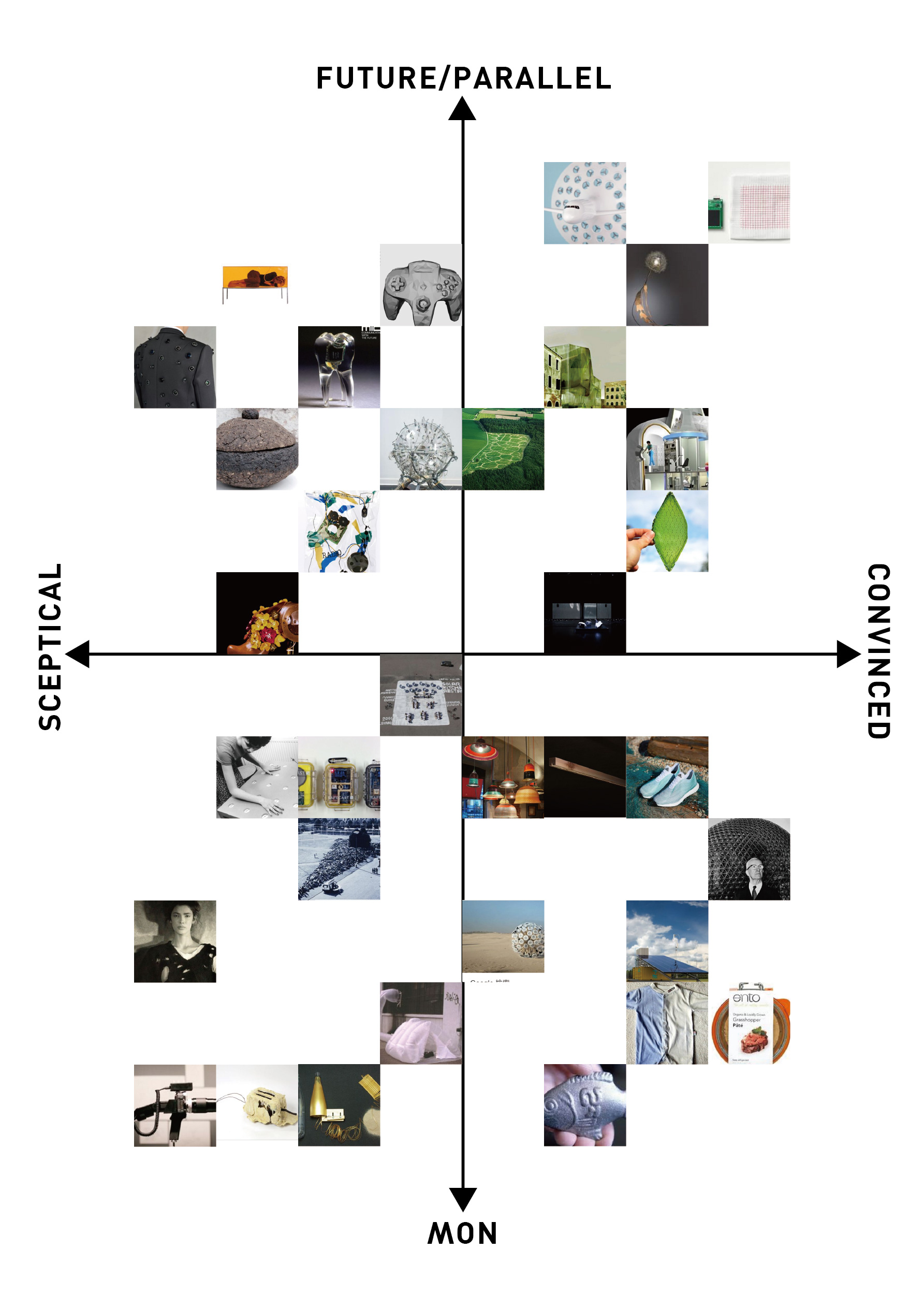
Figure.1: designPeriodicTable1
Here I would like to sort out the existing design attitudes just like that of chemical elements. By doing this, I aim to make the blank spaces of design projects in accordance with their characteristics.
Part 1: Tangiblisation
[1] Dunne & Raby, "CRITICAL DESIGN FAQ," http://www.dunneandraby.co.uk/content/bydandr/13/0.
[2] Guy Julier, "POLITICAL ECONOMIES OF DESIGN ACTIVISM AND THE PUBLIC SECTOR".
[3] SAFECAST, http://blog.safecast.org/.
[4] Thomas Thwaites, "The Toaster Project," http://www.thomasthwaites.com/the-toaster-project/, 2009.
[5] Instructables, http://www.instructables.com/.
[6] Alvaro Catalan de Ocon, "PET Lamp Abyssinia," http://catalandeocon.com/products/pet-lamp-ethiopia/.